Pacific Ocean
On the RoadThe Pacific Ocean is the literal western destination around which Sal Paradise’s travels gather their promise and their uncertainty. It first gives direction to his 1947 departure from home, appears as a vast view from the California coast, and remains a point of orientation in later journeys. Yet reaching the Pacific does not end the road: the ocean marks an edge that the narrative repeatedly approaches, leaves, and crosses in memory or imagination.
Destination and First Westward Journey
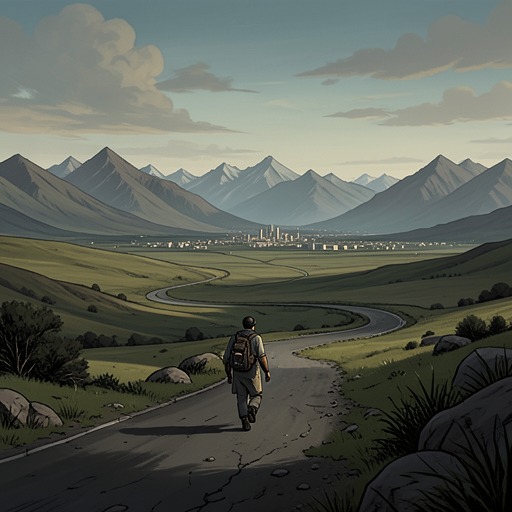
In July 1947, after saving about fifty dollars from veteran benefits, Sal set out for the West Coast. His old friend Remi Boncoeur had invited him to San Francisco, where they might find work aboard an around-the-world liner. Sal was willing to ship out on any freighter if the Pacific voyages could earn enough to support him while he finished his book. He left his half-completed manuscript on his desk, packed a canvas bag, and headed west with the ocean as both practical prospect and promised horizon. The route initially frustrated that westward intention. Sal had studied maps for months and chose Route 6, which ran from Cape Cod toward Ely, Nevada, before dipping south to Los Angeles. To reach it, he traveled north toward Bear Mountain; rain stranded him in the wilderness, where the apparent distance from home and the absence of westward progress made the journey feel precarious. The ocean was not yet in sight, but it already organized his expectations: he was traveling toward the Pacific even when the road seemed to carry him the wrong way.
California: The Ocean as View and Imagined Arrival
The Pacific becomes physically visible when Sal climbs a mountain near Mill City. From the rocky, grassy summit he sees it beyond the foothills, blue and immense, while a wall of fog advances toward the Golden Gate. The view gathers a whole imagined San Francisco into one prospect: its hills, Coit Tower, the Embarcadero, Market Street, and lovers walking beneath the fog. The coast is at once actual geography and a screen onto which Sal projects the life he expects to find there. That vision also sharpens his sense of distance and division. Turning from the coast, Sal imagines the continent’s bulk stretching back toward New York, contrasting what he sees as California’s whiteness and emptiness with the East’s brown, sacred character. The Pacific therefore does not simply complete a westward journey; it gives Sal a vantage from which to look across the country and measure the differences he assigns to its regions. His arrival in the West does not fulfill every promise associated with the water. Sal leaves Mill City without sleeping aboard the Admiral Freebee, the old freighter in the bay that Remi had proposed exploring and that Sal had hoped to inhabit for a night. The ship’s stripped interior and absent copper make the imagined maritime future tangible but unavailable. The Pacific is close, yet the anticipated voyage does not begin there.
Repeated Crossings and the Road’s Horizon
Later journeys give the Pacific a recurring place in Sal’s travel geography. On a bus heading east in October, he reads the landscape as he crosses the Arizona desert, New Mexico, Texas, Oklahoma, and Kansas, then reaches the Mississippi at St. Louis. The return trip makes the ocean a point left behind: going home is narrated against the memory of the western journey rather than as a simple arrival at its end. The road also repeatedly joins the Pacific-bound itinerary to older continental routes and landscapes. Sal recalls the wagon parties at Council Bluffs and the Platte Valley as he travels west with Eddie; later, the journey toward California passes through the Mississippi country, while another eastward crossing takes him through Illinois toward Chicago. These repeated passages make the nation feel less like a single line to the coast than a web of remembered places, river crossings, departures, and returns. The pattern continues in the drive south from New Orleans toward Mexico. After crossing the Mississippi, the party moves west across Louisiana toward the Sabine, with San Francisco still the destination and supplies gathered for the road. Later, in a west-to-east journey, Sal recognizes Newton, Davenport, and Illinois from earlier travel. The Pacific thus remains a directional reference even when the immediate scene lies far inland: movement toward or away from it gives the repeated American landscape its narrative shape.
Boundary, Scale, and Significance
The ocean’s importance lies partly in the contrast between its immense scale and the practical details of reaching it. Sal’s westward plans depend on a small reserve of money, rides, buses, and uncertain work; later travel depends on cars, fuel, passengers, and the risks of speed. The Pacific promises open space, but the journey toward it is made through specific roads, towns, rivers, and material constraints. That tension keeps the ocean from becoming a merely abstract symbol of freedom. At the same time, the Pacific acts as a threshold in Sal’s imagination. From the coast, the continent opens behind him as a single vast expanse; from the road, the ocean stands ahead as the place where a new life might begin. Because the narrative repeatedly sends its travelers back across the same country, that threshold never settles into a final destination. The Pacific is where the westward dream takes visible form, and the horizon from which the road continues.